The WSCA Measurement Toolkit
Two self-assessment tools to help schools and colleges evaluate their whole school and college approach to mental health and wellbeing.
What is the WSCA Measurement Toolkit?
The purpose of this toolkit is to allow educational settings to reflect regularly on the implementation of their WSCA work and track its impact on key outcomes. This can help inform their whole school and college approach work in a targeted way and act as a springboard for discussions with stakeholders.
Educational settings will be able to self-assess their WSCA implementation and outcomes using our two tools: the Implementation Self-Assessment Tool (ISAT) and the Outcomes Self-Assessment Tool (OSAT).
Schools and colleges will also be able to track the self-assessment data over time and develop their WSCA work, making adjustments where needed, based on their progress.
Why do we need a measurement toolkit?
Evaluation of the WSCA is crucial to understand where an education setting's approaches are benefitting the students and to ensure the WSCA meets the needs of pupils, students, families and staff.
In our previous work on the Best Practice Review of the WSCA, we identified that, whilst most MHSTs and educational settings reported using standardised measures for targeted work with individual pupils and students, there was little or no use of measures to systematically monitor and evaluate the impact of the WSCA. So, we set out to develop a tool that all education settings and MHSTs can use.
Who is the toolkit for?
The toolkit is designed for any school or college to use. We suggest that senior leaders within each setting complete the ISAT and OSAT, whilst incorporating the views of pupils, students, parents, carers and staff and evidence from across the setting.
When do I use the toolkit?
The toolkit can be used as frequently as needed, to the extent that this is considered useful for your setting. There is no prescribed time frame, but many settings choose to track outcomes and implementation by comparing ratings made early and late within each academic year.
We do recommend completing the toolkit at two or more points throughout the year to allow settings to view progress and identify any areas that may need more attention.
If you're not sure when to return to it, the toolkit includes a reminder function that can email you when it's time to complete another ISAT or OSAT. If you need to step away before finishing, you can also save a partly completed form and return to it when it suits you.
How was the toolkit developed?
The toolkit was built from the ground up with the people who would use it. Pupils and school staff were involved extensively throughout development, contributing to the criteria that underpin both the ISAT and OSAT and helping to ensure the tools reflect what actually matters in a school or college setting, not just what's easy to measure.
The tools were then tested with 24 schools across the South, South East, and North East of England. Findings from that phase of the work are available to read here.
Development didn't stop there. We have research papers underway drawing on a larger-scale evaluation currently in progress across approximately 300 schools and a smaller qualitative study exploring users' experience of using the tools and impact on their WSCA practice. That ongoing work is helping us to refine the tools, understand how settings are using them, and build the evidence base for WSCA measurement more broadly.
Watch our explainer videos
Learn about the development of the WSCA Toolkit and how to use it:
The Implementation Self-Assessment Tool (ISAT)
The ISAT is a self-assessment form which encourages schools and colleges to reflect on what WSCA work is being done and how it is being implemented in their setting. Schools and colleges will be able to see how their WSCA work is developing over time and whether or not there are certain aspects which are being implemented more than others.
There are 17 criteria for implementation where schools and colleges can rate themselves on each one. Each criterion relates to a particular area of whole-school/whole-college (or whole organisation) work on mental health:
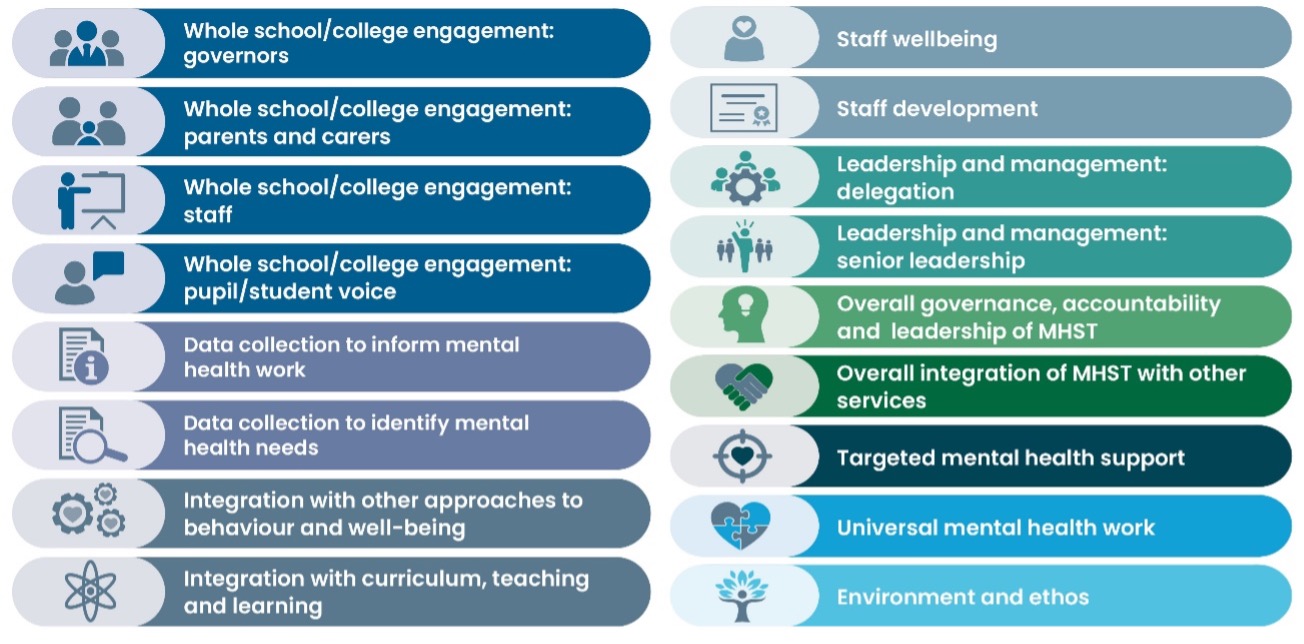
For each criterion, there are four possible ratings which the setting must choose from. These range from: 0 (little or no whole-school/college work in that area) through to 3 (the most embedded and integrated approach to whole-school/college work in that area).
The Outcomes Self-Assessment Tool (OSAT)
The OSAT is a self-assessment form which encourages schools and colleges to reflect on the impact of the WSCA work. Schools and colleges will be able to identify the specific outcomes of their work and see how their WSCA work is impacting the wellbeing of pupils, students and staff and whether or not there are certain aspects that are progressing more than others.
There are 12 criteria for outcomes where schools and colleges can rate themselves on each one. Each criterion relates to a particular area that was considered important in showing the impact of WSCA by pupils, students and staff.
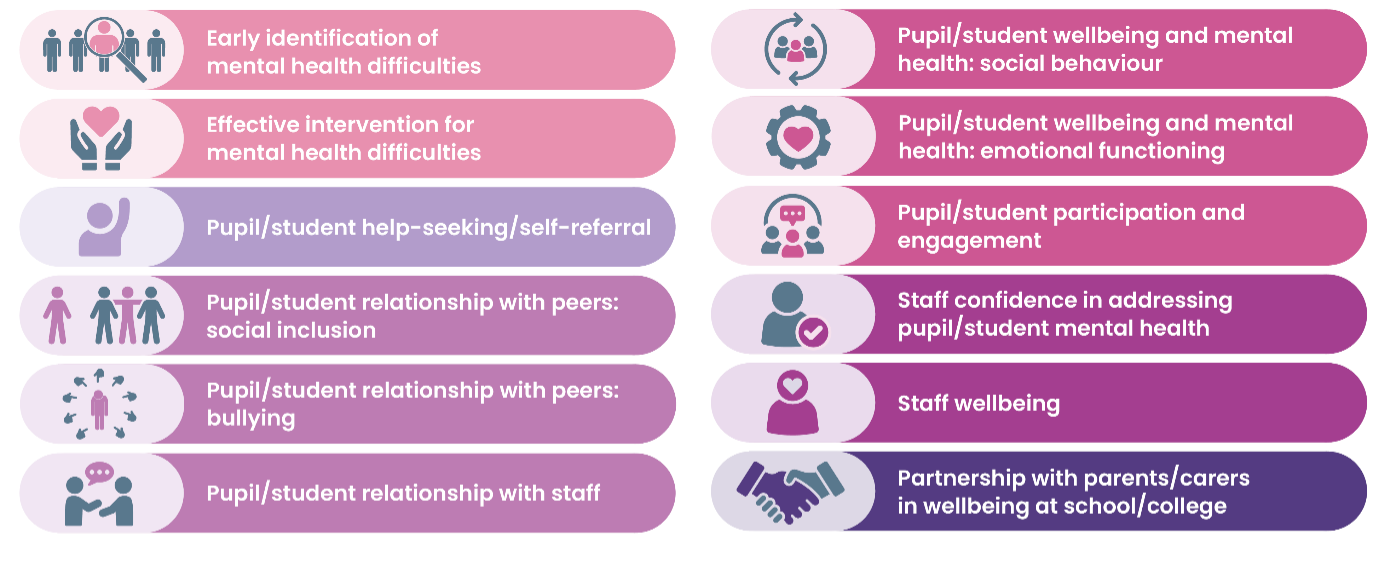
For each question, there are four possible ratings which the settings must choose from. These range from: 0 (little or no indicator of positive outcomes) through to 3 (the strongest indicator of positive outcomes).
In addition, for the OSAT, the setting must also evaluate the quality and depth of evidence they can provide for this assessment. For each question, there are three possible evidence ratings. These range from: 1 (only limited evidence) through to 3 (strong evidence is provided for the outcome rating, with written documentation in line with an agreed plan for data collection, and confidence about the reliability, validity, coverage, and independence of data collection).
Ready to get started?
If your school, college, multi-academy trust, or MHST wants to start measuring your WSCA, you can register for free access to the toolkit today.